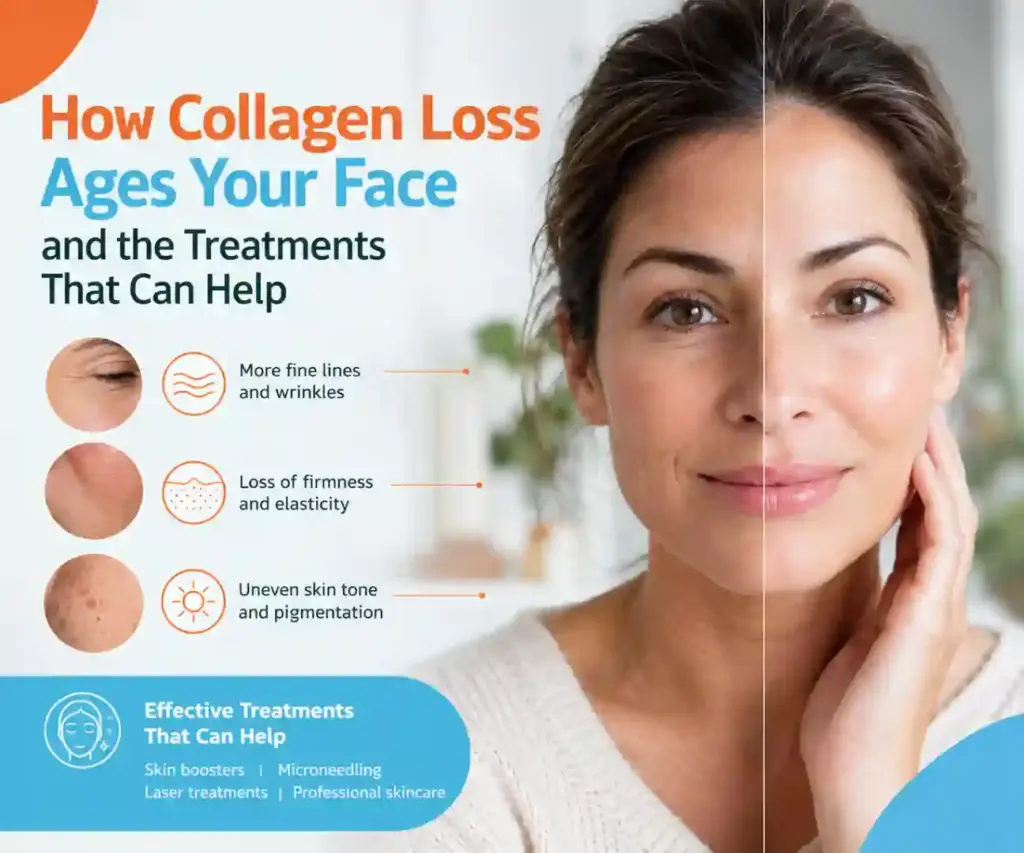
As we get older, it’s natural to notice changes in our skin. Fine lines may become more visible, our cheeks might look less full, or the skin around the jawline may feel less firm than it once did.
Collagen plays an important part in these changes, but it isn’t the whole story.
Facial ageing involves several processes, from changes within the skin itself to the gradual loss of facial fat and changes in the underlying bone structure.
Understanding what’s happening beneath the surface can help you make more informed choices about skincare and cosmetic treatments.
In this guide, we’ll cover how collagen changes with age, how to care for your skin, and where non-surgical treatments such as RF Microneedling and HIFU may fit in.
What Is Collagen and Why Does Your Skin Need It?
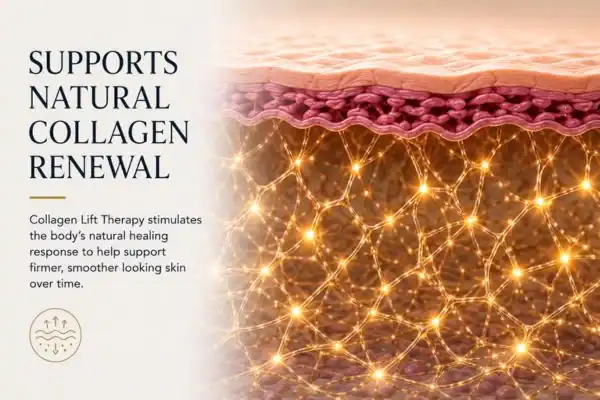
Collagen is a naturally occurring protein found throughout the body, including in the skin, bones, tendons and connective tissues.
Within the skin, collagen forms part of the structure that provides strength and support.
It works alongside other components, including elastin and hyaluronic acid, which contribute to the skin’s flexibility and hydration.
Our bodies continually produce and break down collagen. As we age, this balance changes.
Collagen in our skin can become more fragmented, while the processes that maintain and repair it become less efficient.
These changes are one reason skin may gradually develop fine lines, wrinkles and a less firm appearance.
How Does Collagen Loss Affect Facial Ageing?
Collagen changes are part of normal ageing, but they don’t happen at the same rate for everyone.
You may notice changes in your skin’s texture or firmness long before significant sagging develops.
Common changes associated with facial ageing include:
- Fine lines becoming more noticeable.
- Reduced skin elasticity
- Changes in skin texture
- Crepey-looking skin around certain areas
- Less defined facial contours
- Loose skin around the cheeks, jawline or neck
Not all these changes are caused by collagen loss alone.
Facial fat, muscle activity, bone structure and the skin’s other supporting components also influence how our faces look over time.
This matters when considering treatment because a procedure aimed at skin texture won’t necessarily address a concern caused by facial volume loss.
What Causes Collagen to Change as We Age?
1. Natural ageing
As we get older, our skin produces less collagen than it once did. This can gradually affect how firm and smooth our skin looks, making fine lines and wrinkles more noticeable.
It’s a natural part of ageing, although some people notice these changes much earlier than others.
2. Sun exposure
Ultraviolet radiation can damage collagen and other skin components.
Years of unprotected sun exposure may contribute to wrinkles, pigmentation changes and a rougher skin texture.
Using sunscreen regularly is one of the most practical ways to help protect against further UV-related skin damage.
3. Hormonal changes
Hormones influence several aspects of skin health.
Changes in oestrogen levels around menopause, for example, can affect skin thickness, hydration and collagen.
Some women notice that their skin becomes drier or less firm during this stage of life.
4. Smoking and lifestyle factors
Smoking is associated with premature skin ageing and changes to the skin’s supporting structures.
Nutrition, general health and environmental exposure can also influence skin condition.
However, no single food, supplement or lifestyle change can prevent the natural ageing process.
5. Genetics
Your genes play a part in how your skin ages.
Some people develop noticeable wrinkles earlier, while others retain a firmer appearance for longer.
This is why comparing your skin with someone else’s isn’t particularly helpful when deciding whether a cosmetic treatment is suitable.
Can You Restore Lost Collagen in Your Face?
You may have seen treatments advertised as ways to replace collagen, rebuild the skin or turn back the clock.
These descriptions can make the process sound much simpler than it is.
Collagen is continually remodelled within the skin, but no cosmetic procedure can fully reverse biological ageing or restore your skin to exactly how it looked years ago.
Some treatments are designed to create controlled effects within the skin, aiming to influence its appearance.
Whether those treatments produce a noticeable improvement depends on the procedure, equipment, individual skin characteristics and available clinical evidence.
Be cautious about any treatment that promises dramatic collagen restoration or permanent results.
Can Skincare Help With Ageing Skin?
A consistent skincare routine can help maintain the skin’s condition, even though it cannot eliminate substantial sagging or replace lost facial volume.
Protect your skin from UV exposure.
Broad-spectrum sunscreen with at least SPF 30 helps protect exposed skin from UV-related damage.
Remember areas such as the neck, ears and upper chest, which are often overlooked.
Keep your skin moisturised.
Ingredients such as glycerin, ceramides and hyaluronic acid can help support skin hydration.
Well-hydrated skin may appear smoother, making some fine surface lines less noticeable.
Consider retinoids where appropriate.
Certain topical retinoids have evidence for improving some visible signs of photoageing.
They can also cause dryness and irritation, particularly when first introduced.
Retinoids should be avoided during pregnancy. If you’re breastfeeding or have a skin condition, seek appropriate advice before using them.
Look after your general health.
Eating a balanced diet, avoiding smoking and getting adequate sleep are worthwhile habits for general health.
However, these measures shouldn’t be presented as guaranteed ways to restore collagen or tighten loose facial skin.
What Non-Surgical Treatments Are Available for Ageing Skin?
If your main concern is changing skin texture, fine lines or mild skin laxity, you may be interested in professional cosmetic treatments.
At LA LIPO, we offer selected non-surgical procedures through our mobile service, including Collagen Lift Therapy (RF Microneedling) and HIFU.
Both use energy-based technology, but they work differently.
Neither treatment is suitable for everyone, and results should not be assumed to match surgery.
Collagen Lift Therapy: What Is RF Microneedling?
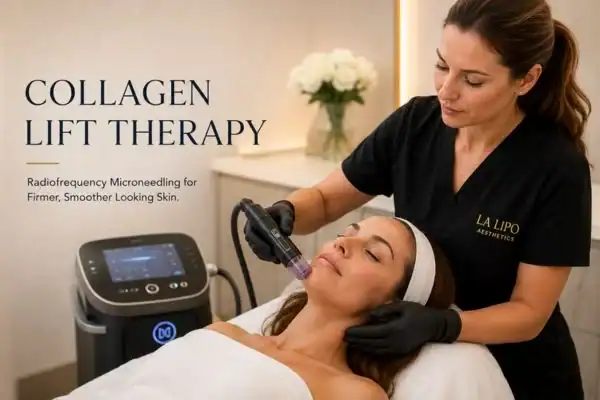
LA LIPO’s Collagen Lift Therapy uses RF Microneedling technology.
The procedure combines fine needles with radiofrequency energy delivered into the skin at controlled depths.
This creates a controlled treatment effect within the skin, intended to encourage a tissue response.
RF Microneedling is used in cosmetic practice for concerns involving skin texture and firmness.
However, it doesn’t directly replace missing collagen, and visible improvements cannot be guaranteed.
What Skin Concerns May Be Discussed During a Consultation?
Depending on individual suitability, RF Microneedling may be considered for concerns such as:
- Fine lines and wrinkles
- Uneven skin texture
- Mild skin laxity
- The appearance of certain acne scars
- Crepey-looking skin
- Skin texture around the face, jawline or neck
Each treatment area must be assessed individually.
Significant excess skin or loss of facial volume may require a different approach.
Learn more: Collagen Lift Therapy – RF Microneedling.
What Happens During RF Microneedling Treatment?
Before proceeding, your practitioner should discuss your concerns, medical history and any factors that could make the procedure unsuitable.
The treatment involves passing fine needles into the skin while radiofrequency energy is delivered at selected settings.
You may experience heat, pressure, or discomfort.
Numbing cream may be used where appropriate, although this doesn’t mean the procedure will be completely pain-free.
After treatment, the skin may appear red, swollen or sensitive. Small pinpoint marks can also occur.
Less common but more serious complications include burns, infection, scarring and pigmentation changes.
Your practitioner should explain these risks, provide aftercare guidance and discuss when medical attention may be needed.
How Long Does RF Microneedling Take to Work?
RF Microneedling isn’t an instant cosmetic procedure.
Any visible changes may develop gradually as the skin responds to treatment.
The timing, extent and duration of any improvement vary between individuals.
Some people may be advised to consider a course of appointments, but the number of sessions should be based on an individual assessment rather than a promise of particular results.
Before booking, ask what evidence supports the expected outcomes for the equipment being used.
Who Might Not Be Suitable for RF Microneedling?
RF Microneedling may be unsuitable or need to be postponed in certain circumstances.
These can include:
- Pregnancy or breastfeeding
- Active skin infections or inflammation in the treatment area
- Certain implanted electronic devices
- Some medical conditions affecting healing
- Particular medications or skin conditions
This isn’t a complete list.
Your practitioner should review your medical history, discuss potential contraindications and assess whether the proposed procedure is appropriate.
What About HIFU for Facial Skin Laxity?
High-Intensity Focused Ultrasound (HIFU) uses focused ultrasound energy to heat tissue at selected depths.
It is used in cosmetic practice for certain skin-firmness and laxity concerns.
Unlike RF Microneedling, HIFU doesn’t involve inserting needles into the skin.
However, this doesn’t mean it’s risk-free.
Possible effects include discomfort, swelling, tenderness and temporary changes in sensation. More serious complications, including burns or nerve-related effects, may occur.
The degree of any visible improvement depends on several factors, and treatment cannot be relied upon to remove substantial loose skin.
Find out more: HIFU Treatment
Can HIFU and RF Microneedling Be Used Together?
The two procedures use different forms of energy and target tissue in different ways.
Some people may enquire about both treatments when they have concerns involving skin texture and laxity.
However, combining them doesn’t automatically produce better or longer-lasting results.
A practitioner needs to consider your skin, medical history, treatment areas, the interval between procedures and any additional risks.
Claims that combining treatments produces superior results require suitable clinical evidence.
Related reading: HIFU and RF Microneedling Together
Can Non-Surgical Treatments Replace a Facelift?
No. Non-surgical cosmetic procedures cannot reproduce the effects of a surgical facelift.
They don’t remove substantial excess skin or fully correct changes involving facial fat and underlying structures.
For some concerns, a surgical consultation may be more appropriate.
Understanding these differences is important before deciding how to proceed.
When Should You Speak to a Healthcare Professional?
Gradual changes in skin texture and firmness are commonly associated with ageing.
However, not every change in the face or skin should be treated as a cosmetic concern.
Contact your GP if you notice a new or changing skin lesion, unexplained swelling, persistent bleeding or a sore that doesn’t heal.
Cosmetic procedures should never replace an appropriate medical assessment.
Choosing the Right Approach for Your Skin
Before booking any cosmetic treatment, identify exactly what you’d like to address.
Is your concern fine lines, uneven texture, loose skin or changes in facial volume?
These are different issues, and they may not respond to the same approach.
A consultation should let you ask questions, understand treatment limitations, and decide whether to proceed.
You should also be told about potential complications, aftercare and any alternative options.
Explore Your Options With LA LIPO
At LA LIPO, we offer selected cosmetic treatments in customers’ homes across areas of the UK where our mobile service is available.
If you’re considering treatment for changes in skin texture or firmness, our team can explain how RF Microneedling and HIFU work and discuss practical appointment arrangements.
We must assess suitability before treatment, and we can’t promise any particular result.
Interested in finding out more?
Contact LA LIPO to arrange a consultation.
Collagen Loss and Facial Ageing FAQs
1. At what age does facial collagen start to decline?
Collagen changes gradually throughout adulthood, but there’s no single age when everyone starts to notice them.
Genetics, sun exposure, hormones and other factors all influence how the skin ages.
2. Does losing collagen make your face sag?
Changes in collagen and elastin can reduce skin firmness.
However, facial sagging is also influenced by changes in fat distribution, connective tissue and bone structure.
3. Can you rebuild collagen in your face naturally?
Your body continues to produce and remodel collagen throughout life.
Good skincare, UV protection and general health habits can help care for your skin, but they cannot fully reverse age-related structural changes.
4. Does RF Microneedling stimulate collagen?
RF Microneedling uses tiny needles and radiofrequency energy to create controlled changes within the skin. The aim is to encourage the skin’s natural repair processes, which can involve collagen remodelling.
This doesn’t mean everyone will see firmer or smoother skin, and any claims about increased collagen production or visible improvements need reliable clinical evidence for the equipment and treatment used.
5. Is Collagen Lift Therapy the same as Morpheus8?
No. Morpheus8 is a branded RF Microneedling system.
LA LIPO’s Collagen Lift Therapy uses RF Microneedling technology, but it should not be described as treatment with the branded Morpheus8 device.
6. Can RF Microneedling help with facial wrinkles?
RF Microneedling is used in cosmetic practice for concerns such as fine lines and uneven skin texture.
However, the results aren’t the same for everyone. Whether you’ll notice a difference depends on your skin, the equipment used and the treatment itself. Your practitioner should explain what the available evidence suggests before you decide whether to proceed.
7. Is RF Microneedling suitable for mature skin?
Age alone doesn’t determine suitability.
Skin condition, medical history, treatment goals and potential risks all need to be considered.
8. How many RF Microneedling sessions will I need?
There isn’t a single treatment schedule that suits everyone.
Your practitioner should explain whether a course of appointments is being considered, why it may be appropriate and what evidence supports the proposed plan.
9. Does HIFU replace lost collagen?
HIFU doesn’t replace collagen that’s been lost through ageing. Instead, it uses focused ultrasound energy to heat specific layers of tissue beneath the skin, aiming to encourage a response that may involve collagen remodelling.
However, this doesn’t guarantee firmer or tighter skin. Any claims about increased collagen production or visible improvements should be supported by reliable clinical evidence for the equipment and treatment used.
10. Can collagen supplements prevent wrinkles?
Research into oral collagen supplements and skin appearance is ongoing.
Some studies report changes in certain skin measurements, but findings are mixed, and evidence remains limited.
Collagen supplements should not be relied upon to prevent wrinkles or stop facial ageing.
11. Can skincare tighten sagging facial skin?
Moisturisers and certain active skincare ingredients may improve aspects of skin appearance.
However, topical products cannot reliably remove substantial loose skin or recreate the effects of surgical procedures.
12. Are non-surgical facial treatments safe?
Non-surgical doesn’t mean risk-free.
RF Microneedling and HIFU can cause side effects and complications. Risks depend on the procedure, equipment, treatment settings, and individual circumstances.
13. How do I arrange a consultation with LA LIPO?
Contact LA LIPO with your location and the skin concerns you’d like to discuss.
Our team can explain which mobile services are available in your area and what information is needed before considering treatment.
Important: HIFU and RF Microneedling aren’t suitable for everyone, and both treatments carry some risks. Results will differ from person to person, so it’s important to understand what you can realistically achieve. Before you proceed, your LA LIPO practitioner will discuss your medical history, explain possible side effects, and talk you through the available options, giving you the information you need to make an informed decision.
For Further Information, Please Call Us ON 03300 100 238